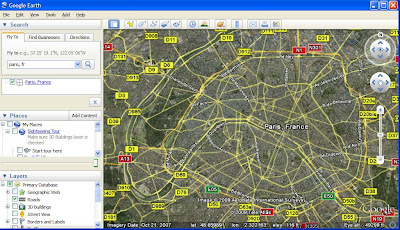
The team over at Google has released a speedier version of their popular Google Earth application. From our tests here, we did notice some welcome speed increases in rendering the map tiles when you zoom in and out and change views. Also, start up time did seem reduced compared to version 5.0. Additionally, Google has sped up the rendering of 3D models within Google Earth. Of course, since RavTrack’s AVL solutions support open formats such as KML, this means that Google Earth is now faster while rendering KML for display with a map overlay. For more information on using RavTrack AVL with Google Earth check out our recent announcement.
From the Google Lat Long blog:
We’ve made a lot of adjustments under the hood, like improving memory utilization so we can show more buildings, layers, and user content. We improved our shaders (that’s graphics-speak for small programs that run inside your graphics processor) to make the atmosphere draw faster. We also worked to reduce stuttering (known as frame drops) to provide an even smoother experience as you fly around the globe. When we draw imagery, we now use compression technology to use less memory and graphics resources. We know that waiting for a program to start-up can be really frustrating, so we improved our start-up time by 25%. In our Google Earth API (which allows developers to include Google Earth right in their websites), we have made API calls significantly faster, which means that our developers can now do even more.
Often, during large-scale construction projects heavy equipment such as bulldozers or front-end loaders are left on site overnight or after hours. It simply does not make sense to move them back and forth. Unfortunately, this can make your construction equipment a target for theft costing tens of thousands if not hundreds of thousands of dollars.
Luckily, any vehicle or piece of construction equipment can be tracked and monitored in real-time using the RavTrack AVL tracking solutions from Raveon Technologies. With RavTrack, you know with certainty where all your work site assets and equipment are located; all in real-time and without the expensive recurring fees that accompany most other AVL systems. Using RavTrack AVL, you can monitor your job site and keep an eye on how your equipment is being used, even in remote areas where other products fail.
On the lighter side of GPS tracking, we came across this incredible video of a robot that uses GPS to find its away around. The Precision Urban Hopper is being developed by Sandia Labs and Boston Dynamics. Using GPS to navigate is nothing new in robotics, but the way the Hopper handles obstacles is pretty unusual.
Sandia said hopping has “shown to be five times more fuel-efficient than hovering,” when it comes to getting around obstacles less than 30 feet tall. (Via CNET)
I just read an interesting article about how trucking fleets are using GPS to calculate their fuel taxes. Since fuel taxes are generally handled by the states and since truckers typically operate across state lines they often need to calculate their usage in various locales. GPS position reporting is a good way to do this as not only would it report your GPS location but it would also report the time for each position report. Ideally, you could automate this process with reporting transmitted as you go.
It is likely that state and local governments will increase their use of GPS to support pay-as-you-go taxation paradigms.
While it seems like a difficult task to calculate your fuel taxes, GPS tracking of your fleet can only make it easier. Consider this description:
This can be an onerous administrative task. If you have a fleet of over 50 trucks, there is a good chance you have one person, perhaps making $40,000 annually, focused solely on this paper-intensive task. But the process can be automated if a company uses GPS/telematics devices in its trucks, along with fuel cards and IFTA tax reporting software (or a tax service provider that uses this kind of software). Then the mileage driven in each state and fuel expenditures for a particular vehicle can be automatically loaded into the software and the proper IFTA reports can be printed. The process becomes much less paper intensive. While a fleet operator would probably never buy a telematics solution solely to eliminate a clerical position, it can contribute to the ROI offered by telematics solutions.
GPS tracking solutions like RavTrack are useful for more than the usual vehicle tracking. You can also use RavTrack to track stolen assets and recover stolen property with GPS. In Fort Launderdale, a tow truck company owner tracked down two of his trucks that had been stolen:
What the culprits didn’t know was that the Ford F-450s were equipped with high-end GPS tracking systems that would chart their every move over the next 36 hours.
Fort Lauderdale police arrested two men for the theft of the wreckers, which had wireless GPS tracking hardware installed on them. Police used GPS position reporting to capture the suspects.
Jason Parrett, owner of the Fort Lauderdale repossession truck company First Response Towing and Recovery, said the Global Positioning System units were crucial to finding the missing wreckers.
“Without it we wouldn’t have found the trucks,” said Parrett, who has equipped all three trucks in his fleet with GPS technology.
Parrett said an employee called him early Saturday to tell him the two trucks were missing.
Once Parrett figured out which two trucks were gone, he asked his wife to pull up their locations on her BlackBerry, which is linked to their GPS units.
When the police arrived, the owner provided the GPS system’s activity report, which showed where the trucks had been, places where they had been parked for extended periods and how fast they had been driven. The police later arrested the two men at one of the locations listed on the GPS report.
“The detailed activity reports in these are disgustingly accurate,” Parrett said of the system.
Last week, Raveontech announced their Atlas PL, personal GPS locator. The Atlas PL is ideal for tracking emergency response teams, search and rescue personnel, wildfire teams and firefighters, as well as security teams. It has many useful features suited for tracking personnel with GPS including some new and advanced safety features including: automatic “Man-Down” alert, manual alert, critical alert, and proximity alerts that are transmitted along with position and status. Read more information on the Atlas PL GPS personnel tracking system and these new safety features.
In Washington, D.C., the traffic authorities responsible for the local commuter bus system there have developed a new service for sharing the position of each bus in real-time. The new service is quaintly called “Where’s my Bus?” and displays the GPS position of your bus. The service is viewable via the web or from any Internet-enabled smartphone such as the iPhone or Blackberry. Obviously, this improves the service in a significant way in that riders no longer have to worry where the bus is and can use the bus system more efficiently. We expect the trend of sharing GPS position data for individual vehicles to continue, especially in consumer-focused services such as commuter transport or car services and limousines. It is easier to be patient when you know exactly where your bus or taxi is located at any time while you wait.
The District Department of Transportation’s Gabe Klein explains the value of the “Where’s my Bus?” service:
DDOT Director Gabe Klein says it’s a new world. “I think smart phones are becoming the norm for people in urban environments.”
Customers now want information, on demand, any time and anywhere. “In the winter, it’s cold. Wouldn’t you rather be waiting in your office for 9 or 10 minutes?”
Using GPS technology, DDOT’s application allows riders to track each bus down to a tenth of a mile. From Klein’s office at 14th and U Streets, he tests the programs accuracy. “I’m going to hit refresh and sure enough, it’s at 14th and T.”
Officers found at least 12 of the 25 vehicles have been reported stolen. Authorities are calling it a major auto theft operation.
Authorities spent most of the afternoon and evening hauling away stolen vehicles that were to be stripped and sold for parts. Authorities also seized two guard dogs that were on short chains.
In the future, we can expect that all assets of significant value will include a GPS tracking device. Not only could it help you track down your stolen property, but it might also help you remember which neighbor borrowed your tools.
One area where GPS technology will see greater improvements is in how it is used within large buildings and other interior spaces. Currently, it is difficult to receive GPS signals through walls and structures, but this reach can be improved with GPS repeaters and other ground-based systems. One can imagine how useful this might be in locating company personnel within a corporate office building, hospital, etc. In addition to fleet tracking your vehicle fleet you could also have a handle on all your staff in real time. Here is an article about how current GPS technology is being extended.
The system is being currently tested in Finland. In fact, it is not the first indoor system but the others have mostly been for specialist uses, such as helping firefighters find colleagues in smoke-filled buildings. This system, developed by Nokia, will work with existing handsets and infrastructure, according to the scientists.
One thing it does need, however, is access to maps of the inside of buildings. This may not be feasible for private homes, but many public sites such as big sports centres and universities already make maps available.
Perhaps as building information modeling becomes standard, public spaces will be able to submit mapping data to GPS mapping data providers or through a distributed system of mapping data?
I was reading this article earlier today about how a stolen ambulance was recovered using the vehicle’s GPS transponder. Obviously, this is just one more benefit to tracking your vehicle fleet with GPS-based solutions. It may even be possible that insurance companies will factor the presence of GPS tracking systems into your company’s insurance policy, which could result in discounts to damage coverage since vehicles should be easier to recover if lost or stolen. Likewise, if a vehicle is lost or stolen it can be recovered in less time and with less impact to your fleet capacity. Eventually we will see more and more equipment tracked in real time with GPS.
A recent study by C.J. Driscoll and Associates shows that fleet vehicles, construction equipment, and mobile workers account for about 3.6 million GPS devices in use in the United States. This number is expected to increase to about 6.5 million by the year 2012 as more businesses realize the benefits of GPS fleet tracking in terms of fuel savings, asset tracking, and overall efficiency. We expect these trends to continue until all commercial vehicle fleets adopt GPS fleet management as central to their logistic efforts.
One of the issues with the accelerated economic growth of the developing world is the reliability of road and mapping data. In many places like Dubai and China construction is taking place at such a rapid pace that municipal authorities cannot assign addresses fast enough to meet demand. Likewise, in other places like India, existing mapping data is simply unreliable. This is where GPS can be ideal as GPS uses your specific position and geographic coordinates, which makes it immune to problems that plague traditional mapping systems that use street names and other arbitrary assignments of position.
In places like Nagpur, India, city officials are meeting such challenges by installing fleet management systems in their ambulances and emergency vehicles in order to best respond to emergencies and disasters:
Dr Pradhan said that whenever anybody calls 102, the control room can track the ambulance nearest to the spot and direct it to the place. “OCHRI has installed the device on all its six ambulances as well as those of other private hospitals,” he said.
Dr Noorul Amin, senior medical officer and in-charge of Emergency Medical Services at OCHRI, said that GPS technology uses radio waves to calculate the distance between vehi Dr Pradhan said these ambulances would have one hospital staff capable of providing first aid at the spot itself. He also underlined the need for providing all life-saving medicines in them. He said the project was brainchild of NMC commissioner Aseem Gupta.
Fleet management using GPS is an ideal way to quickly respond and deploy your assets to react to crisis quickly. This is a trend we expect to continue.
Many companies are starting to see the benefits of tracking their fleets with GPS-based solutions in terms of fuel cost savings and more efficient route planning. With GPS, you can constantly optimize your routes, which will add directly to the bottom line over time through more efficient use of resources. American Airlines recently reported an investment of $400 million to upgrade its entire fleet with GPS navigation systems to operate more efficiently:
“I think we are going to save several thousand pounds of fuel on this one flight,” he said.
And that could mean more cost savings for American, which spent $9 billion on jet fuel in 2008, if it is allowed more trans-Atlantic flights that use the new technology. The carrier has said it wants to save 120 million gallons of fuel and reduce carbon emissions by 2.5 billion pounds this year.
Flight 63 will use an optimized route determined by GPS, not a route predetermined by air traffic controllers. GPS lets controllers track a plane all the way across the Atlantic, even when it’s out of radar range, unlike the Air France plane that disappeared from radar last week. GPS would help maintain appropriate separation among planes.
In addition to the cost savings and reduced environmental impact, GPS will help avoid tragedies like the disappearance of the Air France flight over the Atlantic.